Explore How Hydrating Hair Products Transform Dry And Damaged Hair
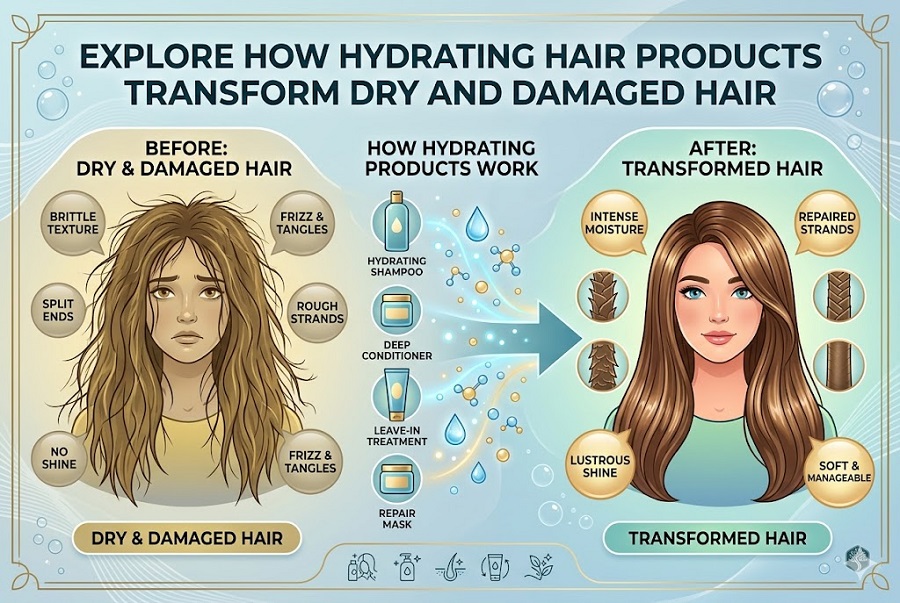
Somewhere between the third box dye and the daily flat iron, hair just gives up. Not dramatically – it doesn’t announce itself. It just gets quieter. Less shine. More snap. That weird texture where it looks fine in photos but feels like straw the second you touch it. If that sounds familiar, the problem probably isn’t your hair. It’s that your hair has been running on empty for a while and nothing you’re using is actually filling it back up.
Moisture and Water Are Not the Same Thing
This tripped me up for years honestly. Wetting your hair in the shower is not hydrating it. Water sits on the surface, gets absorbed temporarily, and then evaporates – especially if the cuticle is already compromised from damage. What hydrating hair products actually do, the good ones at least, is introduce ingredients that bind to moisture and keep it inside the hair shaft rather than letting it walk straight back out once you turn the blow dryer on.
Humectants are the key player here. Glycerin, hyaluronic acid, panthenol – these pull moisture from the air and from deeper layers of the hair fiber and hold it. Pair those with emollients that seal the cuticle down afterward and you’ve got something that actually works past the first hour after washing. Without that sealing step the moisture just escapes anyway and you’re back where you started by the next morning.
Most regular conditioners skip the second part. They coat. They soften temporarily. They’re not built to repair a damaged cuticle that’s been forced open from bleach or six months of 400-degree heat.
The Routine Matters More Than Any Single Product
Here’s something nobody really wants to hear – one good mask isn’t going to fix two years of damage. Doesn’t matter how expensive it is or what the before and after photos look like. Dry, damaged hair got that way through repetition and it recovers the same way.
What actually moves the needle is layering. A cleanser that doesn’t strip the little moisture your hair is managing to hold onto. A conditioner that adds more. A leave-in that bridges the gap between wash days so the hair isn’t starting from zero every time you step in the shower. And if the damage is real – like chemically processed, bleached, heat-fried real – a weekly treatment on top of that.
Hydrating hair products work as a system. Pull one piece out and the others can only do so much.
What Changes When It’s Actually Working
Elasticity comes back first and that’s honestly the best sign. Damaged hair snaps – healthy hair stretches a little and returns. Once the moisture levels stabilize the hair starts behaving differently under your fingers before you even notice it visually.
Then the frizz situation changes. Not because anything is weighing the hair down – that heavy, greasy feeling is what happens when you use the wrong formula – but because a sealed cuticle genuinely doesn’t absorb humidity the way an open damaged one does. The frizz that shows up every time it rains isn’t a weather problem. It’s a cuticle problem.
Color holds longer too. Keeps its tone instead of going brassy or dull within two weeks of the appointment. Processed hair that’s properly moisturized is more stable – less porous, less reactive, less likely to keep oxidizing after you leave the salon.
Conclusion
Dry and damaged hair is not a permanent state. It just feels that way when nothing in the routine is actually addressing the right problem. Consistent use of the right hydrating hair products changes the hair’s behavior from the inside out – not overnight but steadily, wash by wash, until one day you realize you haven’t thought about frizz in two weeks. That’s what working actually looks like. Not a dramatic before and after. Just hair that quietly stops being a problem.